 Ephemundi
←
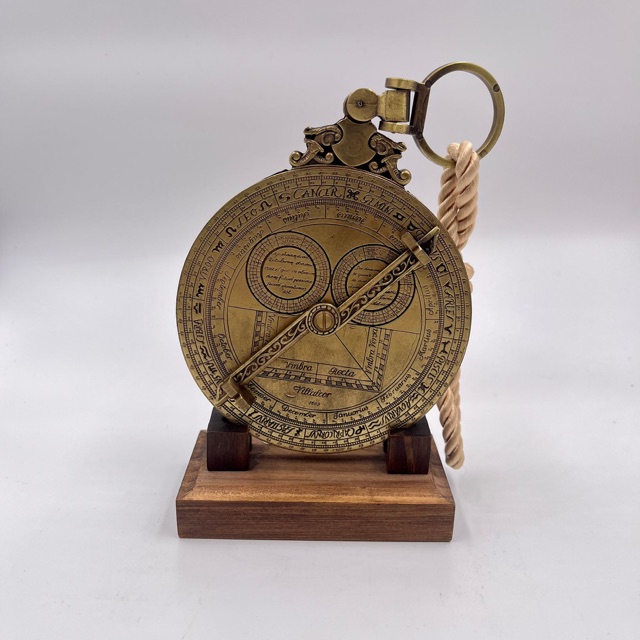
Inventory no. 030 — The Traveller’s Cabinet
Astrolabe
Sold
- Origin
- Spain
- Period
- 21st century
- Material
- Bronze-plated metal
- Dimensions
- ⌀ 10 × 13 cm
- Collection
- The Traveller’s Cabinet
€90
View this piece in the houseOne-of-a-kind piece. Insured shipping, in France and abroad. Fourteen days to withdraw after receipt.
Detailed notice
Origin: Spain.
Maker: Antiquus (Viejos Inventos).
Period: 21st century.
Material: bronze-plated metal.
Size: diameter 10 cm × 0.8 cm; height 13 cm.
Condition: new (replica).
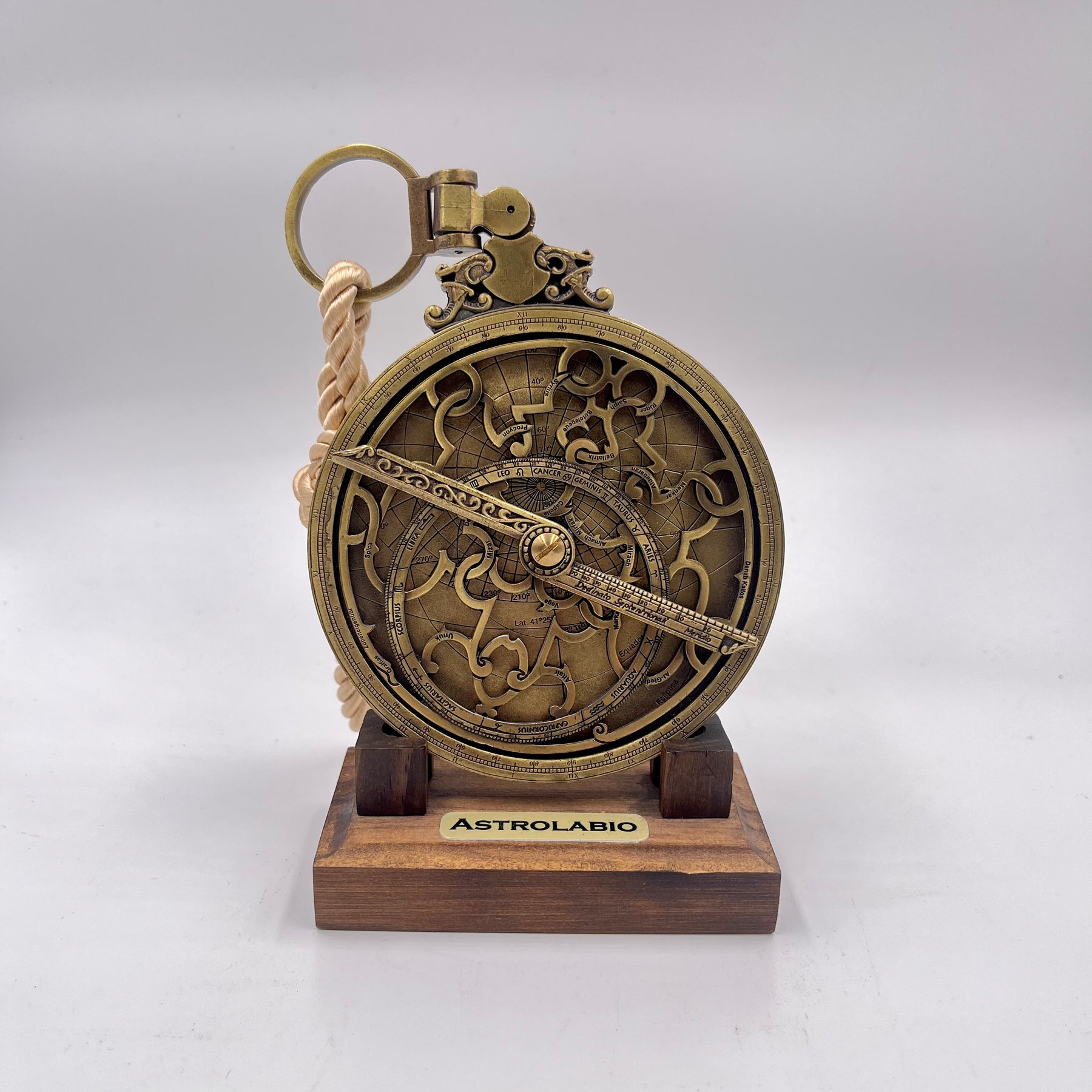
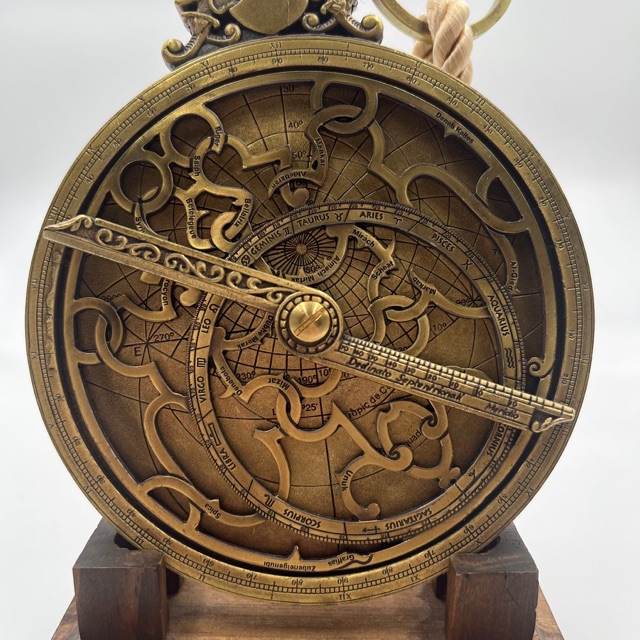
The astrolabe is an instrument at the crossroads of astronomy, mathematics and history. With it, astronomers and scholars could find the position of the stars, tell the time and work out the latitude of a place.
The word comes from the Greek astron, star, and lambanein, to take: the astrolabe is the "star-taker". Its principle, the stereographic projection of the sky onto a flat surface, goes back to Greek astronomy: it is often credited to Hipparchus (2nd century BC) and is described by Ptolemy. Astronomers of the Islamic world brought the instrument to a high degree of refinement, notably in Baghdad in the 9th century, at the time of Caliph al-Ma'mun and the House of Wisdom. One of the oldest dated astrolabes known, made by Nastulus around 927, is kept in Kuwait.
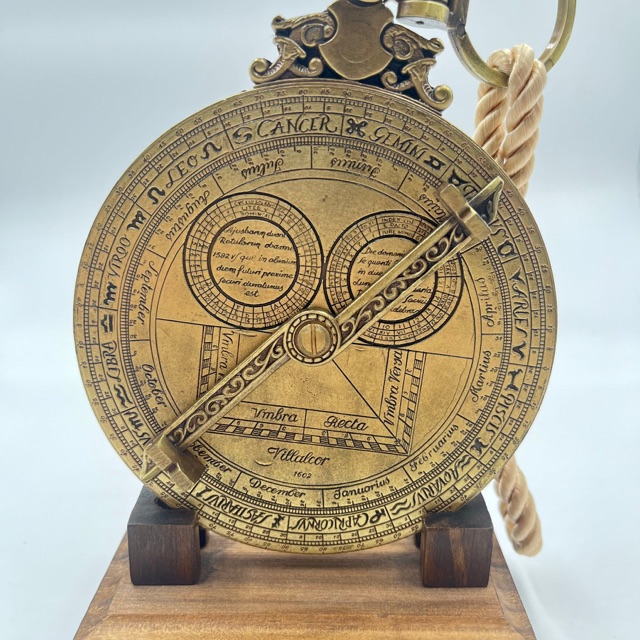
This replica by Antiquus is inspired by an astrolabe made by Gualterus Arsenius in Leuven in the late 16th century. It is a planispheric astrolabe, the most common type, built on a stereographic projection; such instruments often had several plates engraved for different latitudes, so that they could be used in different places. It is mounted on a wooden base inscribed "Astrolabio" and comes with a booklet on its history and use, in a presentation box with a stand.
Note: this astrolabe is set for a latitude of 41° 25′.